
I had this post saved as a draft, and never published it! See my response to the weekly prompt below.
Seimens and Connectivism
I have to admit that for the longest time, I did not know that Connectivism was coined by Siemens exclusively! Oddly, I’ve known about the concept for some time, but glad I can now match a face (from the video) with the  name!
name!
I appreciated that this reading brought in the learning theories that formed the foundation of our understanding of human learning. It was good to have a concise review of these theories (behaviorism, etc.) since I haven’t had a chance to review them in every course. Knowledge sharing and knowledge acquisition are set apart in many ways, particularly in how quickly most of it becomes outdated. The half-life of learning has also contributed to the shift from formal education to communities of practice, learning communities, social networks, and field practice. Siemans (2005) explains that technology has served as a transformative element, changing how we learn and how we think. (pp. 1-3).
Knowledge sharing and knowledge acquisition are set apart in many ways, particularly in how quickly most of it becomes outdated. The half-life of learning has also contributed to the shift from formal education to communities of practice, learning communities, social networks, and field practice. Siemens (2005) explains that technology has served as a transformative element, changing how we learn and how we think. (pp. 1-3). This complicated process is rooted in
Kolb and Experiential Learning
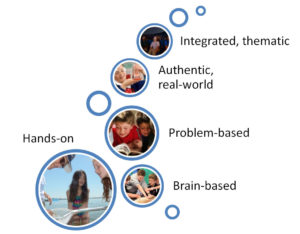 Experiential learning reminds me of a purist approach to teaching and learning theory. Like Connectivism, it draws on several aspects of the human psyche, such as perception, cognition, behavior, etc., that directly affect learning. Between the different learning models (Piaget, Dewey and Lewin), we can see a common thread involving how the learner shapes their learning through experiences. To that end, learning requires repetition, constant adjustment and is continuous in its true form.
So…What’s the difference?
I do not think that there is much of a difference between the two. From my understanding, Connectivism is a type of experiential learning. I think the biggest difference is who is driving the learning. Through one lens, it is the learner (Connectivism) and the other seems to emphasize the experience that is the primary reason learning happens (Kolb, 1984, pp. 20-21). However, both theories drive home that the optimal learning environment is not instructor-driven or transmittal, but rather student-centered and shaped by the student experience. Additionally, they are both messy processes, with Connectivism also assuming that “learners are actively attempting to create meaning. Learners often select and pursue their own learning” through real-life experiences (Siemens, 2005, pp. 1-3). In both cases, learning happens through experiences and is driven by the learner.
It appears, though, that Connectivism does emphasize the group over the individual, and leverages the collective knowledge that can be gained from the experiences of others.
A brief word about accessibility
One thing I’d like to keep in mind when discussing how technology leverages these patterns in teaching and learning is accessibility. While many resources opt for heavy visual design, we do have an increase in the number of students who benefit from closed captioning and other accessibility tools. SO when we are thinking about the “last level” of connected learning that Siemens references in the video resources for the week, I think we should also consider how accessible these social networks are to our students before we use them in our instructional design projects.